Albert Linda

Postdoctoral researcher · Max Planck Institute for Sustainable Materials, Düsseldorf, Germany

I connect the atomic scale to the microstructure of metals and alloys, using density functional theory, atomistic calculations, phase-field and microstructure modelling, and machine learning.

Google Scholar · GitHub · LinkedIn · ResearchGate

Albert Linda
Background: grain coarsening simulated live in your browser. Click to nucleate a recrystallised grain.

About

I am a computational materials scientist at the Max Planck Institute for Sustainable Materials. My current work spans density functional theory (DFT), atomistic calculations, phase-field and microstructure modelling, and machine learning in materials science. I am interested in how defects and local chemistry at the atomic scale decide the microstructure and mechanical behaviour of metals and alloys.

I am originally from Hazaribagh in Jharkhand, India. I did my Ph.D. in Materials Science and Engineering at IIT Kanpur, working on stacking faults, grain-boundary segregation and grain growth. Before that I studied at IIT (BHU) Varanasi (M.Tech.) and NIAMT Ranchi (B.Tech.).

Alongside the science I write research software, from a desktop structure builder to Quantum ESPRESSO tooling. Most of it is open source.

News

  • AtomForge v0.3 released, with Windows and Linux builds.
  • Charge-density representation learning paper published in J. Chem. Inf. Model.
  • Released SOTC and QEPP on GitHub.
  • First public release of AtomForge.
  • Abnormal grain growth paper published in Acta Materialia.

Research highlights

Selected results, with figures from the papers.

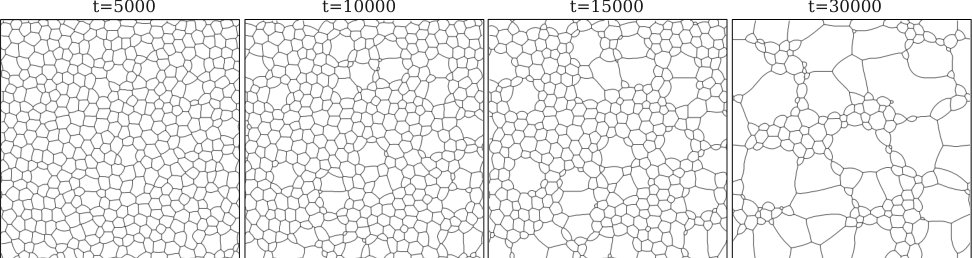
Four phase-field microstructures at increasing time: uniform grains that develop a few abnormally large grains
Phase-field grain growth with 10% high-mobility boundaries. A handful of grains escape and consume their neighbours.

Why some grains grow abnormally

Abnormal grain growth undermines the microstructure control that heat treatment is meant to give. We computed segregation energies of nine solutes at three types of ⟨110⟩ tilt boundaries in α-Fe with DFT and fed them into phase-field simulations. Abnormal growth comes from grain-boundary anisotropy, and how strong it is depends on the solute. When roughly 10–30% of boundaries are highly mobile, grains develop crown-like shapes and grow abnormally.

Acta Materialia (2025) · paper · arXiv
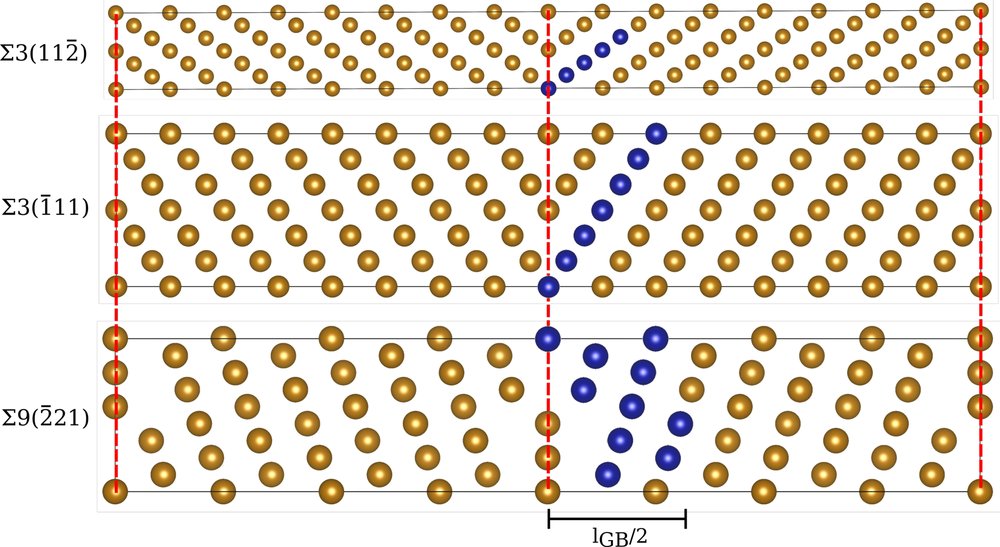
Atomic structures of three symmetric tilt grain boundaries in iron with the boundary region highlighted
Σ3 and Σ9 symmetric tilt boundaries in α-Fe used for site-by-site segregation energies.

Solute segregation from first principles

Site-resolved DFT segregation energies give phase-field models physically grounded input instead of fitted parameters. The same approach explains how Cr slows grain growth in nanocrystalline Fe.

Comput. Mater. Sci. (2025)
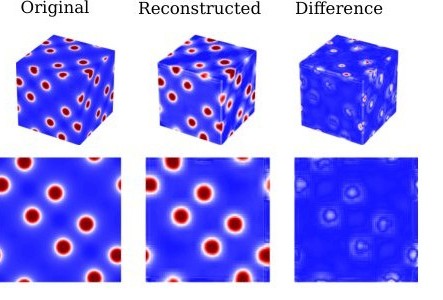
Original and autoencoder-reconstructed electronic charge density of Mg2Pd, with their difference
Charge density of Mg2Pd: DFT, autoencoder reconstruction and the difference.

Learning from the charge density

A 3D convolutional autoencoder compresses DFT charge densities of about 6,000 compounds into a compact latent vector. That vector predicts elastic moduli, formation energy and Debye temperature.

J. Chem. Inf. Model. (2026) · code

I have also worked on stacking-fault energies of FCC metals under pressure and their prediction with machine learning (Phys. Rev. B 2024, Materialia 2022), and on solid-solution strengthening in high-entropy alloys with experimental colleagues (Acta Mater. 2022).

Selected publications

All publications →

Software

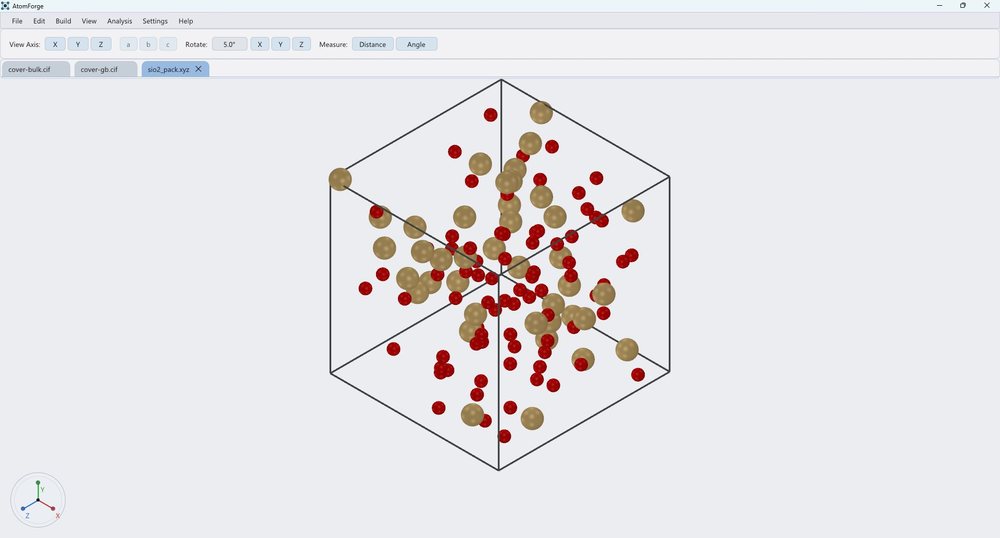
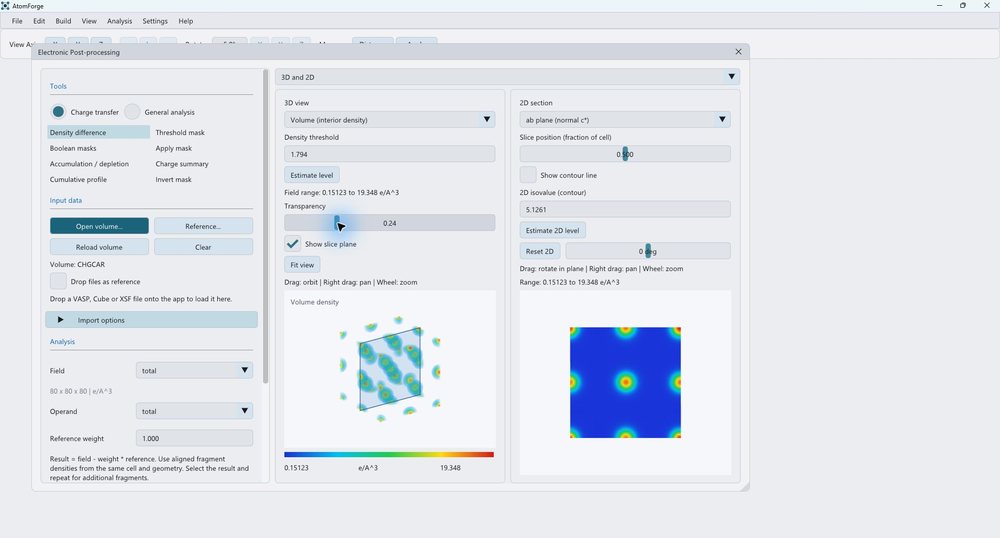
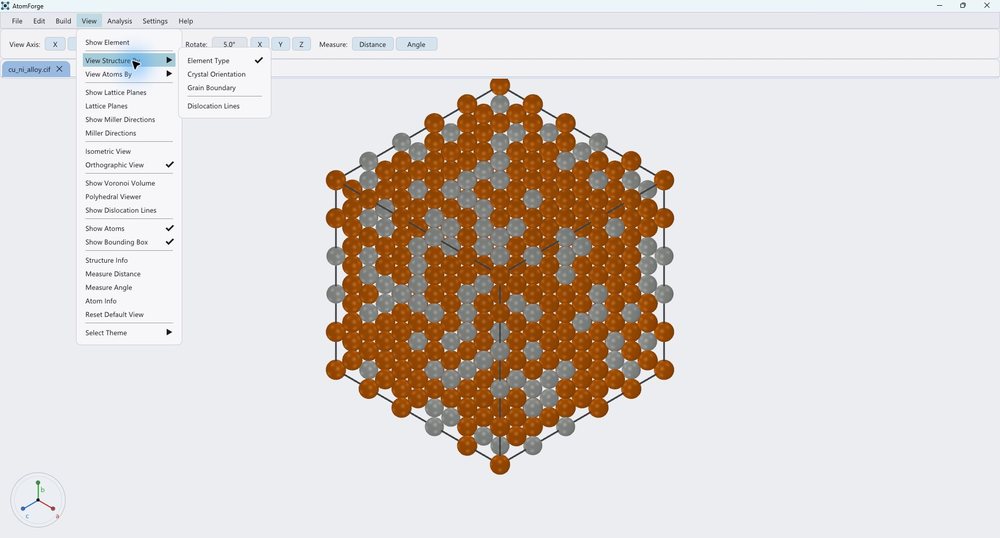
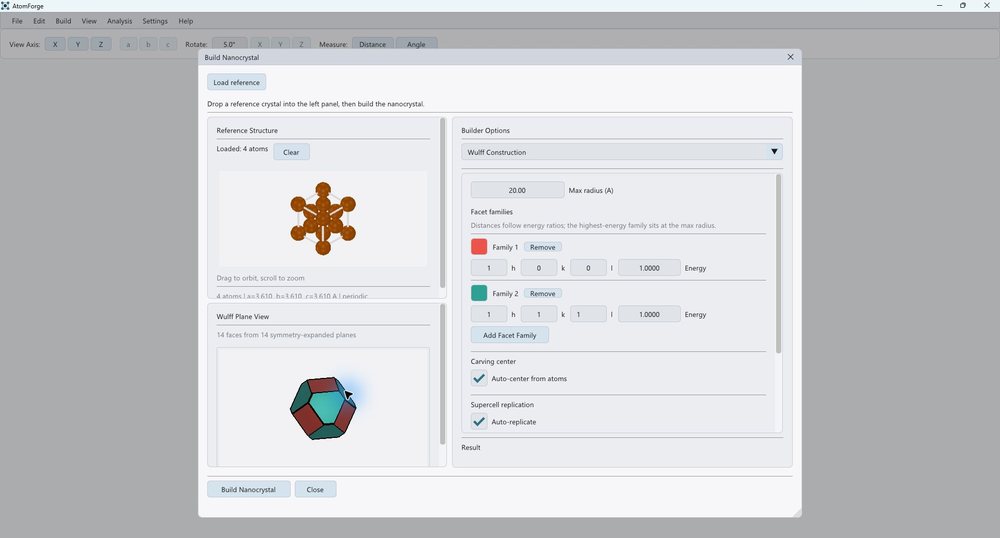
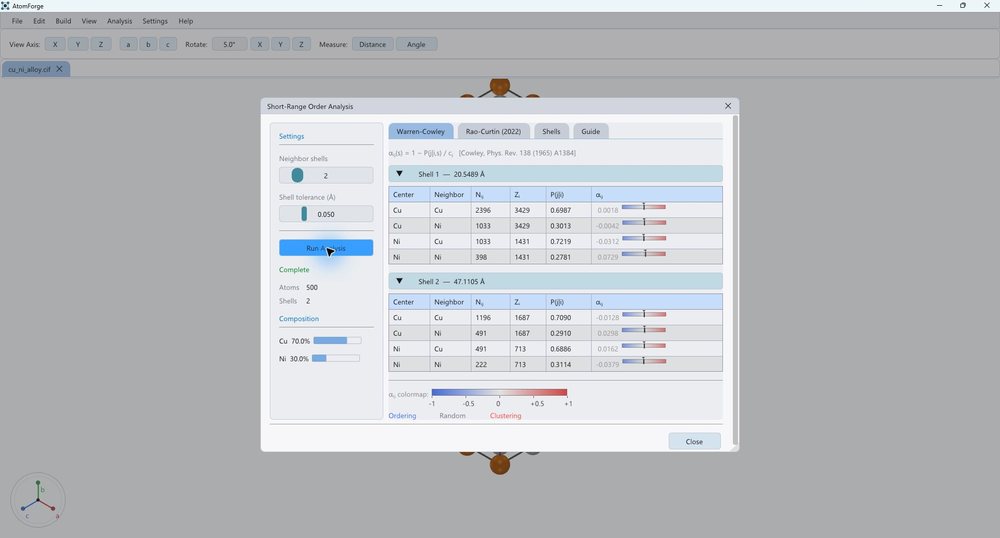
AtomForge main window with menu bar, toolbar, file tabs and an amorphous silica structure AtomForge electronic post-processing window showing a charge-density isosurface and slice AtomForge main window with the View menu open over a Cu-Ni alloy nanoparticle AtomForge nanocrystal builder with a Wulff shape preview AtomForge short-range order analysis dialog with per-shell tables
Main window: an amorphous SiO2 model with several structures open in tabs

AtomForge

C++ desktop application · Windows and Linux

A structure builder and viewer for atomistic modelling. It prepares inputs for MD and DFT and inspects the results in the same window.

  • Bulk crystals from space groups, and solid-solution alloys
  • CSL grain boundaries and Voronoi polycrystals
  • Wulff nanoparticles and structures filling any mesh
  • Electronic-structure visualisation and an illustrated manual

SOTC

Python · phonons

High-temperature phonons and thermodynamics from one small, optimised supercell instead of hundreds of stochastic snapshots.

QEPP

C++ · Quantum ESPRESSO

Input generation and analysis for Quantum ESPRESSO: bands, DOS, elastic constants, phonons and quasi-harmonic properties.

LatentMatFusion

Python · machine learning

Property prediction from VASP charge densities; the code behind the JCIM 2026 paper.

All software and browser tools →